Posts

The fallacy of British Raj on the Subcontinent
Image
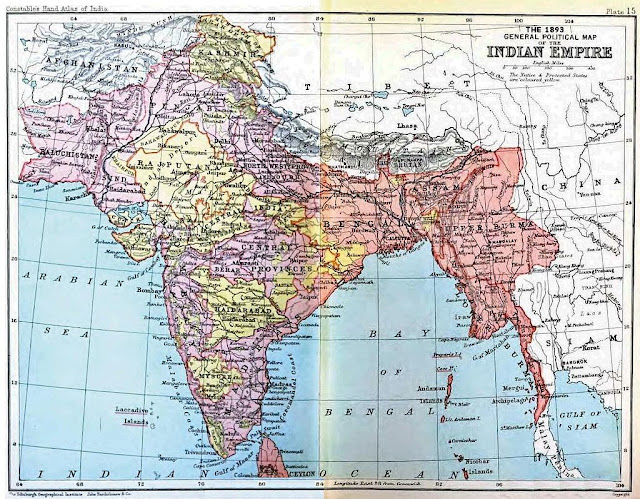
The below discussion was a result of an argument between me and an Indian nationalist on Quora.  This might be considered controversial, however, I feel facts or more important than nationalist feelings and propaganda.  Feel free to leave a comment. In my discussions with many Liberal Indian Nationalists, I have come across a sort of victim mentality and bitter resentment towards the British Raj on the subcontinent. The 'complaints' are of two nature in my experience. The first is that the 'Indian Subcontinent' was looted and it was this money that financed the Industrial Revolution in mainland Britain. The second is that if the British had not 'looted' the subcontinent, it would have been a far more developed and prosperous land. More conservative Indian religious nationalists also make a similar argument against 'the Muslims'. However below I am only going to discuss the claims against the British. To begin with, it is important to understand that when...


Great times for housing real estate in Pakistan

Image
  Investing is not an overly complicated process if you have the basics right. Everyone wants to be like a techie, sitting in front of the computer, clicking or typing away, and making money. But the reality, as many have already said, is quite boring. It requires research, grit, and also knowing one’s own preferred style of investing which can be based on the ability to take the risk, family background, available resources, aims, and so on. I myself have always been interested in seeing opportunities arise through reading macroeconomics and wider trends in the economy. Without a doubt, I read a lot and my intuition (the ability to see patterns) plays a role as well. This doesn’t mean I am Nostradamus, or that I can actually make money in the markets. However, I can write about what I feel are good opportunities. In 2012, it was quite obvious to me that the US is a great market for real estate investment. At the same time I predicted that by the end of the decade, Pakistan’s water ...

How should one feel during High-Performance?

Image
  We know high performers, in the field of management, sports, art, academia and other crafts, have to go through a considerable level of daily stressors. In fact, it is often thought that stress and anxiety are inevitable when achieving high-quality results in a competitive environment, especially one where the margin of error is small or there are time constraints.   This is a common stream of thinking, in high-performance fields as well as everyday perception. We have all seen Gordon Ramsay screaming at his staff when things go wrong at a Michelin starred restaurant. We have seen Serena Williams erupt into a bullying frenzy when she lost. We all know of stern bosses who have no problem in confronting and resolving problems, even if requires a considerable amount of screaming.   But the question is, is that how one is supposed to feel in a high-performance situation? Is there a correct ‘feeling to feel’ in a high-performance situation?   Well, as is usually the cas...

Can we create our own luck?

Image
      I have been reading about luck and probability and its part in the equation for success. We have all heard the age-old phrases of how ‘successful people create their own luck’, or ‘the harder you work, the luckier you get’ and even ‘luck favours the prepared’. But can luck actually be created? Well yes and no. There are two things overall involved in making ‘chance work for you’. One is about positive reframing so that you feel lucky and the other is to get the odds in your favour. In fact, both of these feed into each other as well. Lets break it down.     Reframing the past events Our past has lead us to our present. Many view their past as a series of events that were partly random and partly by design. When we reframe our past as ‘good luck’ that has brought us to today and recognize how our life is better than it was yesterday, you suddenly loose the cynicism and embrace a kind of gracious attitude towards life. Not only does it make one happier, but ...

Atomic Habits: The filler book Preview

Image
  I was about to buy this book that I came across, Atomic Habits: An Easy And Proven Way To Build Good Habits And Break Bad Ones By :  James Clear The title of the book if obviously catchy and I was about to buy it, HOWEVER, I went through a few Amazon reviews and found out that this book is probably one of those 'filler books', with an ounce of knowledge spread exhaustively across approx 2-300 pages. The idea of 'Atomic Habits', is simply what every Behavioural therapist or CBT practitioner already knows. Taking baby steps towards a particular goal. The idea is that a) sometimes that's all it takes b) its a precursor to a bigger change which itself can seem challenging. Now the idea of taking baby steps is nothing new, and there are many variations on the idea as well. Some emphasize the frequency of practice eg a daily practice if one if a singer to practice that increases in intensity in order to create a new lasting habit. Then there is the idea of 'derailin...

Science of breathwork

Image
Just watched a video on BBC reel, talking about yogic breathing and the many related health benefits it brings. There were people in the video learning the art in India and claiming that it had helped them change their life forever.   Whenever I look at such videos or articles about breathwork and its benefits, my mind simply goes back to the classic book 'Relaxation Response' by Dr Herbert Benson . This book, I believe was a seminal work in western literature and brought the idea of breath and relaxation to the general scientific-minded audience. In fact, it helped to ‘rationalize’ these spiritual and esoteric practices to a large extent. When discussing the introduction of breathwork and other spiritual practices to the west, one cant go without talking about Jon Kabat-Zinn who essentially made meditation secular, and accessible in the west. These two authors and researchers have done the most to introduce, clarify, and explain the benefits of breathwork in the mod...

Psychology of Change for the businessperson

Image
While going through a wonderful book written by H.E Stanton about the psychology of trading, I came across a simple concept. Dr H.E Stanton himself has had considerable experience as a performance coach and is a clinical psychologist himself. In short, he knows how to apply theory to practice, something that I am very interested in. In one of the chapters, Dr Stanton goes on to discuss the psychology of change, and rather than going full-on theoretical, he discusses a very simple to understand, practical, and from the viewpoint of an academic, unconventional idea. He discusses the model of change as described by Tony Robbins. His choice to use Tony Robbin's ideas, someone who has no academic background of psychology is intriguing. It speaks to Dr. Stanton's pragmatism if anything. The model is simple a) decide what you want b) identify what is stopping you c) associate pain to not changing and pleasure to enable change, d) interrupt the existing pattern e) create a ...